Testament (2011 – oggi) è un progetto concettuale in corso di Sabine Delafon, nato da un atto ossessivo di raccolta e reinterpretazione di uno degli oggetti più simbolici dell\’identità e dello status: il biglietto da visita. In Testament, l\’artista sovverte la mitologia del biglietto da visita, trasformando ogni biglietto in un manufatto unico di 10 x 7 cm firmato da un altro artista, confondendo i confini tra paternità, scambio ed eredità artistica.
La sua pratica è guidata da un fascino rituale per i nomi, le firme e gli accordi silenziosi incorporati nell\’atto di dare e ricevere. Attraverso questa collezione in continua espansione, costruisce un archivio alternativo di reti artistiche, in cui la presenza è segnata non solo dalla creazione ma soprattutto dal consenso. “Devi semplicemente rispondere positivamente a questo messaggio”, dice al suo destinatario – frase che riecheggia gli enigmatici comandi di Alice nel Paese delle Meraviglie – una bottiglia con l\’etichetta ‘Bevimi’, dove un semplice gesto mette in moto una trasformazione irreversibile.
Presentata in un piccolo formato in edizione limitata, ogni carta è stampata nelle sue dimensioni reali, offrendo un\’esperienza intima e tattile del progetto di Delafon. Il libro diventa un oggetto concettuale in sé, un archivio di connessioni e scambi, in cui la presentazione minimalista invita lo spettatore a riflettere sul significato di ogni firma e sulla persona che vi si nasconde. Allo stesso tempo autoritratto e gesto collettivo, Testament è una meditazione sulla natura fluida dell\’identità e sui modi in cui gli artisti si iscrivono nella storia, non attraverso la propria mano, ma attraverso le mani degli altri.
Sabine Delafon è un artista francese che vive in Italia.Le sue principali aree di interesse sono l\’identità umana, l\’amore e la spiritualità. Ha un approccio concettuale che privilegia la ripetizione principalmente attraverso la fotografia. Il mezzo del viaggio è preponderante per la raccolta di segni (firme, cartelli, quadrifogli, fototessere etc). La modalità seriale è intrinsecamente legata ad un\’opera che si costruisce e si arricchisce nel tempo. Questa serialità rappresenta una continuità ed un rigore, una riflessione sulla pazienza, il rito, il (non) cambiamento, l\’accumulo. È una continua variazione sul tema.
—
Testament (2011 – today) is an ongoing conceptual project by Sabine Delafon, born from an obsessive act of collecting and reinterpreting one of the most symbolic objects of identity and status—the business card. In Testament, Delafon subverts the business card mythology, transforming each card into a unique 10 x 7 cm artifact signed by another artist, blurring the lines between authorship, exchange, and artistic legacy.
Her practice is driven by a ritualistic fascination with names, signatures, and the silent agreements embedded in the act of giving and receiving. Through this ever-expanding collection, she constructs an alternative archive of artistic networks, where presence is marked not only by creation but primarily by consent. “You simply need to reply positively to this message,” she tells her addressee—a phrase that echoes the enigmatic commands of Alice in Wonderland–a bottle labeled “Drink me”, where a simple gesture sets an irreversible transformation into motion.
Presented in a tiny limited-edition format each card is printed in its real dimensions, offering an intimate, tactile experience of Delafon’s project. The book becomes a conceptual object in itself—an archive of connection and exchange, where the minimalist presentation invites the viewer to reflect on the meaning behind each signature and the persona behind it. At once a self-portrait and a collective gesture, Testament is a meditation on the fluid nature of identity and the ways artists inscribe themselves into history—not through their own hand, but through the hands of others.
Sabine Delafon is a French artist living in Italy.Her main areas of interest are human identity, love, and spirituality. She adopts a conceptual approach that emphasizes repetition, primarily through photography. Travel plays a central role as a means of collecting signs—signatures, street signs, four-leaf clovers, photo booth portraits, etc. The serial format is intrinsically tied to a body of work that evolves and enriches itself over time. This seriality represents continuity and discipline, a reflection on patience, ritual, (non)change, and accumulation. It is a continuous variation on a theme.
Presentazione del libro Testament, di Sabine Delafon. Con Sabine Delafon e Vera Maglioni
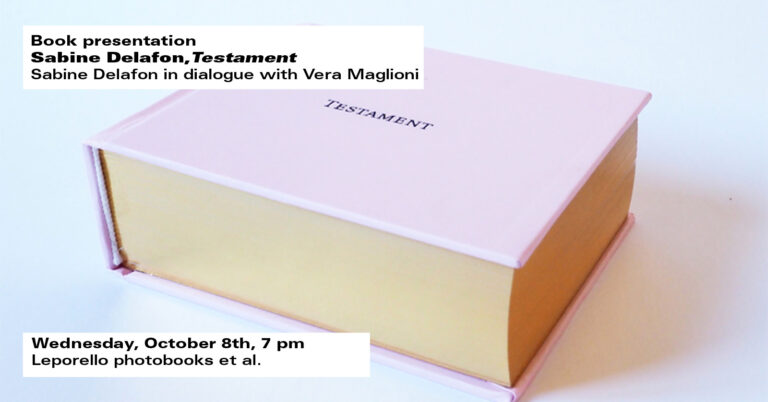 MERCOLEDÌ 08/10 2025

Leporello
libreria dedicata all'editoria fotografica
Via del Pigneto, 162/E, 00176 Roma RMSito webhttps://leporello-books.com/
Telefono06 83976283
Emailinfo@leporello-books.com
Loading...
Loading...
Loading...
Loading...